Federal, state, and NWA municipal grease trap regulations — what they require, what documentation proves compliance, and how Ozark Grease Pros keeps your records current at every service cycle.
FOG stands for Fats, Oils, and Grease — the collective term for the organic material that commercial kitchens generate and that, when mismanaged, causes significant damage to municipal sewer systems, waterways, and public health infrastructure. FOG compliance refers to the body of federal, state, and local requirements that mandate how food service operators must manage that waste.
For a restaurant in Northwest Arkansas, FOG compliance is not optional. It is a condition of your food service permit. Inspectors check for it. Municipalities enforce it. And the cost of non-compliance — fines, permit suspension, kitchen closure, and sewer damage liability — is substantially higher than the cost of maintaining a compliant grease trap service program.
FOG compliance requirements operate at three levels — federal, state, and local — and each level adds specificity to the obligation:
Level
Governing Body
What It Requires
Federal
U.S. Environmental Protection Agency (EPA)
EPA Pre-Treatment Program (40 CFR Part 403) — requires commercial food service operators to control FOG discharge into publicly owned treatment works (POTWs). Grease traps are the mandated control device.
State
Arkansas ADEQ (Arkansas Dept. of Energy & Environment)
State-level pre-treatment standards and discharge regulations. ADEQ oversees permits for grease processing facilities. ADEQ rules may supplement or exceed federal minimums
Local
NWA Municipal FOG Ordinances (Fayetteville, Springdale, Bentonville, Rogers, etc.)
City-specific FOG management programs. Typically require grease trap installation, sizing, maintenance frequency, documentation, and annual permit compliance. Most specific and most directly enforced.
Municipal FOG programs in Northwest Arkansas vary by city, but most share a common core of requirements derived from the EPA pre-treatment framework and ADEQ standards. The following represents the typical compliance framework across the primary NWA markets — always confirm specific requirements with your city’s utility or health department:
Compliance Requirement
What It Means for Your Restaurant
Grease trap installation
Any food service establishment that discharges to the municipal sewer system is typically required to install and maintain an appropriately sized grease trap or interceptor as a condition of their food service permit.
Trap sizing requirements
Regular maintenance and pumping
Manifest documentation
Licensed disposal destination
Records available on demand
Annual FOG permit renewal
Some NWA municipalities require annual renewal of a FOG management permit, which may include a facility inspection and review of service records. Non-renewal can affect food service permit status.
City-specific FOG compliance resources:
FOG ordinance requirements vary by municipality. Contact your city’s public works department or wastewater utility for the specific requirements that apply to your facility. The following NWA cities have active FOG management programs:
→ Fayetteville, AR — City of Fayetteville Water & Sewer Department
→ Springdale, AR — City of Springdale Water Utilities
→ Bentonville, AR — City of Bentonville Public Works
→ Rogers, AR — City of Rogers Water Utilities
→ Siloam Springs, AR — City of Siloam Springs Water Department
Note: Ozark Grease Pros can advise on general FOG documentation requirements but is not a regulatory body. Always confirm specific municipal requirements with your city authority or a qualified compliance consultant.
The waste manifest is the cornerstone of FOG compliance documentation. When a health inspector or FOG program administrator asks for proof of compliance, the manifest is what you show them. Here is exactly what a compliant manifest must contain — and what Ozark Grease Pros provides on every service call:
Manifest Field
What It Documents
Ozark Grease Pros Provides
Date of service
When the trap was serviced — establishes the interval since the prior service
Yes — date recorded on every manifest
Restaurant name & address
Which facility was serviced — matches the permit address
Yes — facility address on every manifest
Gallons removed
Volume of waste extracted — the billing basis and compliance volume record
Yes — measured and documented on every manifest
Hauler company name
Who performed the service — must be a licensed pumping company
Yes — Ozark Grease Pros listed as hauler
Disposal destination
Where the waste was taken — must name a licensed receiving facility
Yes — our Siloam Springs, AR facility listed
Technician signature
Authentication of the service record
Yes — signed on every service call
Waste type
Confirms FOG waste designation — required for regulatory tracking
Yes — waste type documented
FOG non-compliance is an operational and financial risk that most restaurant operators significantly underestimate. The consequences escalate from minor compliance findings to kitchen closure depending on the severity and frequency of violations. Here is the typical enforcement escalation sequence:
Non-Compliance Scenario
Typical Consequence
Missing or incomplete service manifest
Compliance finding at health inspection. Corrective action required — typically immediate service and documentation before re-inspection.
Overdue pumping (trap at or near capacity)
Compliance finding. May trigger immediate pumping requirement as a condition of continued operation. Depending on severity, may affect food service permit status.
Grease entering the municipal sewer system
Active FOG violation. City FOG program notification. Fines possible — amounts vary by municipality. May trigger increased inspection frequency.
Repeated FOG violations at the same facility
Progressive enforcement: increased inspection frequency, higher fines, and in some municipalities, requirement to install a larger interceptor at owner expense.
Grease causing a sewer blockage or overflow
Most serious outcome. Sewer overflow remediation is expensive and the responsible party (the upstream food service operator) may be held liable for remediation costs.
Operating without a current food service permit
Immediate closure risk. FOG compliance issues that are not resolved before permit renewal can result in permit denial.
Disposal at unlicensed site (by hauler or operator)
Environmental violation. ADEQ enforcement possible. Liability extends to the food service operator if their waste is traced to an unlicensed disposal event.
The simplest way to avoid every one of these outcomes:
A scheduled grease trap maintenance program with manifest documentation at every cycle eliminates the documentation gap, keeps the trap below capacity, ensures licensed disposal, and maintains a continuous compliance record. Every risk in the table above disappears when the trap is on a proper maintenance program.
Ozark Grease Pros does not just pump grease traps — it produces the compliance documentation that NWA restaurant operators need. Here’s how every element of our service maps to a specific FOG compliance requirement:
What We Provide
Compliance Requirement It Satisfies
Signed waste manifest on every call
Primary FOG documentation record — satisfies municipal demand for proof of service at health inspections
Gallons removed documented per cycle
Volume-based compliance verification — proves service was at adequate frequency relative to trap capacity
Disposal at licensed Siloam Springs facility
Licensed destination requirement — manifest names an ADEQ-regulated receiving facility, not an informal site
Interior cleaning on maintenance program cycles
Condition-based compliance — demonstrates active maintenance beyond minimum pump-only standard
Baffle & pipe condition check every visit
Equipment maintenance requirement — demonstrates trap is in proper working order, not just emptied
Manifest archive available on request
Record retention requirement — service history accessible for health dept. review or FOG audit
ADEQ-compliant disposal at Siloam Springs
State-level pre-treatment compliance — waste processed at a facility operating under ADEQ permit
What the Inspector Checks
What 'Passing' Looks Like
Service manifest on file
Most recent manifest dated within the required service interval. All fields complete. Licensed disposal destination named.
Manifest history
Multiple manifests showing consistent service frequency — not just one recent pump after a long gap.
Physical trap condition
Trap is not at or near capacity. No overflow evidence. Baffles intact. No visible blockage at inlet/outlet.
Absence of kitchen odor
Persistent grease odor may indicate the trap is at capacity or bacteria accumulation — either can prompt closer inspection.
Trap size adequacy
The inspector may assess whether the installed trap is appropriately sized for the kitchen volume. Under-sized traps are a common finding.
Hauler licensing
Some municipalities verify that the listed service provider is a licensed pumping company. Ozark Grease Pros is licensed.
Disposal destination
The manifest destination must name a licensed facility. Our Siloam Springs facility is licensed under Arkansas ADEQ.
If you have an inspection scheduled and your grease trap is overdue or undocumented, see our emergency service page for priority service before an inspection.
While the core compliance framework is consistent across NWA, each city administers its FOG program through its own utility or public works department. The following provides the general compliance context for the primary NWA markets Ozark Grease Pros serves:
City
FOG Compliance Context
Fayetteville, AR
Fayetteville Water & Sewer has an active FOG management program. The city's restaurant density — driven by the University of Arkansas and a dense urban dining district — creates significant FOG compliance enforcement activity. Manifests requested at routine health inspections.
Springdale, AR
Springdale Water Utilities administers the city's FOG program. High food service density along the I-49 corridor and significant food manufacturing presence make FOG management a priority. Restaurant operators should confirm current service interval requirements.
Bentonville, AR
Bentonville Public Works oversees FOG compliance in the city's growing restaurant market. The Walmart HQ ecosystem and rapid dining scene development have driven increased FOG program enforcement activity. New restaurant operators should confirm grease trap sizing requirements before opening.
Rogers, AR
Rogers Water Utilities administers the city's FOG program. Rogers has a high density of chain and fast-casual restaurants — a segment with high FOG output and correspondingly strict compliance monitoring. QSR operators should plan for monthly service.
Siloam Springs, AR
Our facility home. Siloam Springs Water Department administers local FOG compliance. Primarily serves as the disposal and processing site for our own direct service accounts and B2B haulers.
Bella Vista & Centerton
Benton County communities with growing food service density. FOG programs vary — confirm specific requirements with Bella Vista Utility Corporation and the City of Centerton.
Surrounding communities
FOG programs for smaller NWA communities vary. Contact Ozark Grease Pros for guidance on documentation requirements in specific communities within our service area.
FOG regulations exist because unmanaged grease waste causes serious, measurable harm. Sanitary sewer overflows (SSOs) caused by FOG accumulation in municipal lines are among the most common sewer system failures in the United States — and they result in raw sewage discharges to streets, storm drains, and waterways.
In a growing region like Northwest Arkansas — where population growth and food service expansion have accelerated the volume of commercial kitchen FOG entering the sewer system — the infrastructure implications of poor FOG management are significant. The municipalities that enforce FOG ordinances are not engaged in regulatory theatre; they are managing a real infrastructure and environmental problem that has measurable consequences when ignored.
For restaurant operators, this context is worth understanding. FOG compliance is not an arbitrary bureaucratic requirement — it is a direct connection between your kitchen’s grease management practices and the condition of the public sewer infrastructure and waterways that serve your community. Compliance is both a legal obligation and a straightforward environmental responsibility.
Ozark Grease Pros’ recycling facility addresses this at the processing level. Read more about the environmental significance of grease recycling →
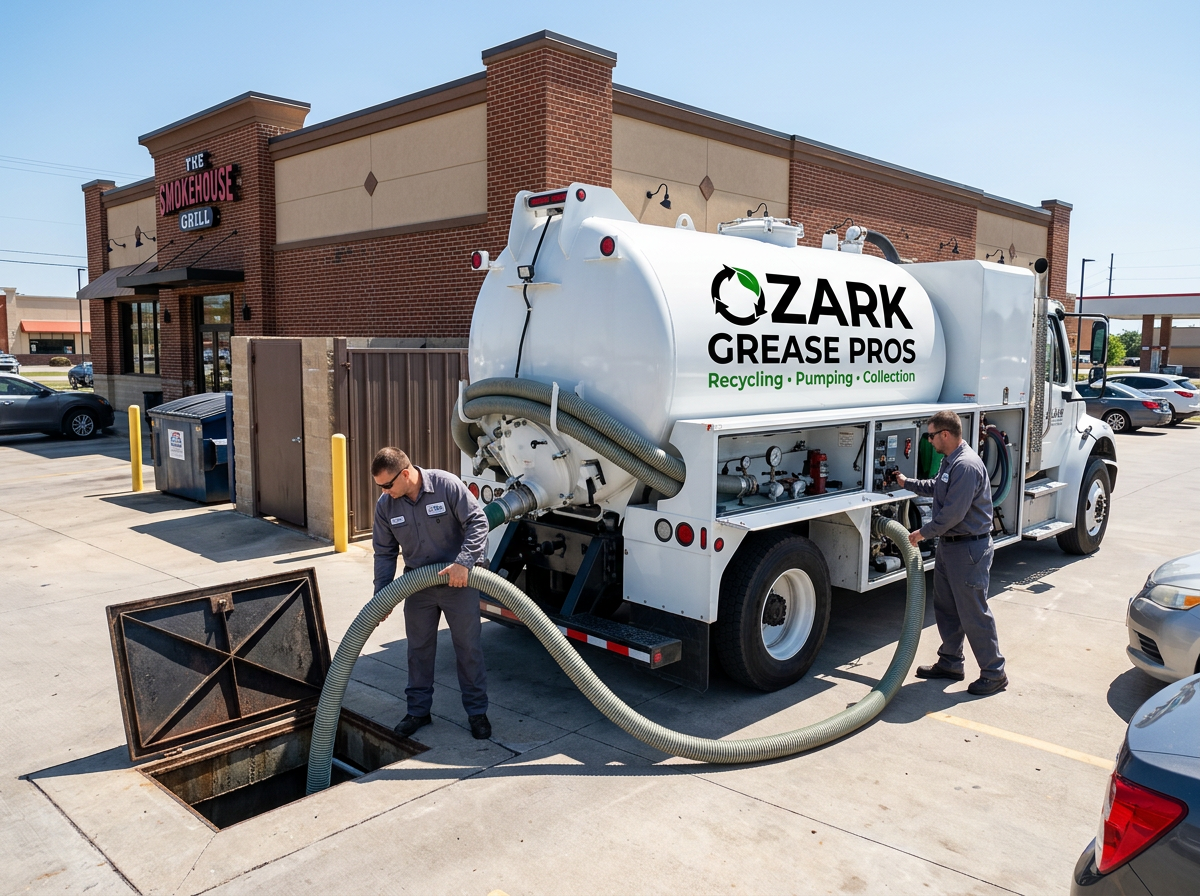
FOG compliance refers to the set of federal (EPA pre-treatment), state (ADEQ), and local (municipal FOG ordinance) requirements that mandate how commercial food service operators manage fats, oils, and grease. For a restaurant in Northwest Arkansas, FOG compliance is a condition of the food service permit — it requires a properly sized grease trap, regular documented service, and waste disposal at a licensed facility.
Pump frequency requirements vary by municipality and trap size. Most NWA FOG ordinances require service often enough to prevent the trap from exceeding 25% capacity — in practice, this means monthly service for high-volume QSR operations, bi-monthly for most full-service restaurants, and quarterly for lower-volume or larger-interceptor operations. Confirm specific requirements with your city’s FOG program administrator.
The primary compliance document is the waste manifest — issued by your service provider on every pump. It must include: service date, facility address, gallons removed, licensed hauler name, disposal destination (a licensed facility), and technician signature. Manifests should be kept on file for at least 12 months and made available to inspectors on demand.
Consequences range from a compliance finding requiring corrective action (most common for documentation gaps) to fines, permit review, and in severe cases, operational impact. Repeated violations can trigger escalating enforcement. The simplest prevention is maintaining a continuous service record with manifests from every pump cycle.
Yes. Every Ozark Grease Pros service call produces a fully compliant signed manifest documenting date, gallons removed, and disposal at our ADEQ-regulated Siloam Springs facility. Our service satisfies the primary documentation requirement at all three regulatory levels — federal, state, and municipal.
A health inspection covers a broad range of food safety requirements. FOG compliance is a subset of that — specifically the grease trap maintenance records and trap physical condition. Some NWA municipalities conduct dedicated FOG inspections separate from routine health inspections; in others, FOG checks are part of the standard inspection. Either way, the required documentation is the same: signed manifests from licensed service.
Using a recycling facility — like our Siloam Springs plant — satisfies the licensed disposal destination requirement at least as well as a disposal-only facility, and provides additional environmental compliance value. For restaurants with sustainability commitments or environmental permit conditions, documented recycling disposal can provide additional compliance benefit beyond the standard FOG record.
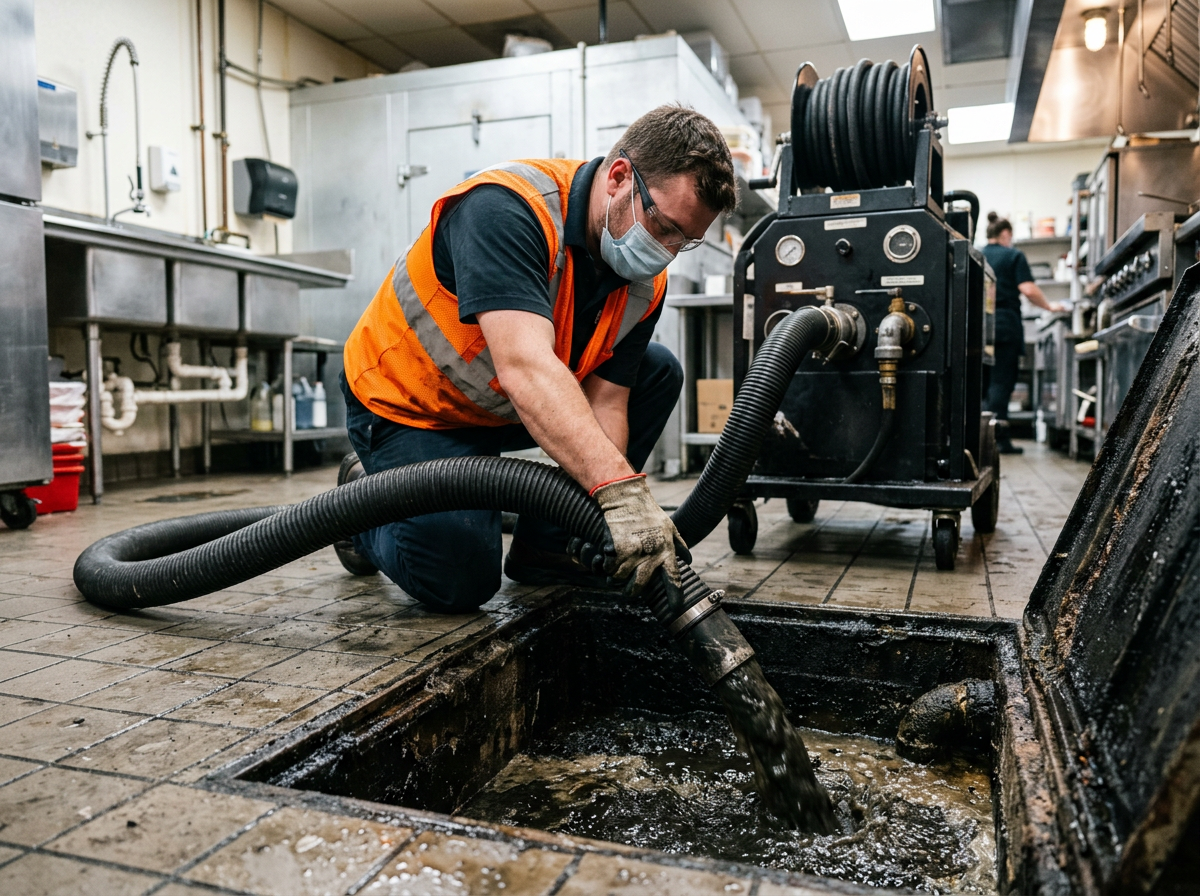
Grease Trap Pumping
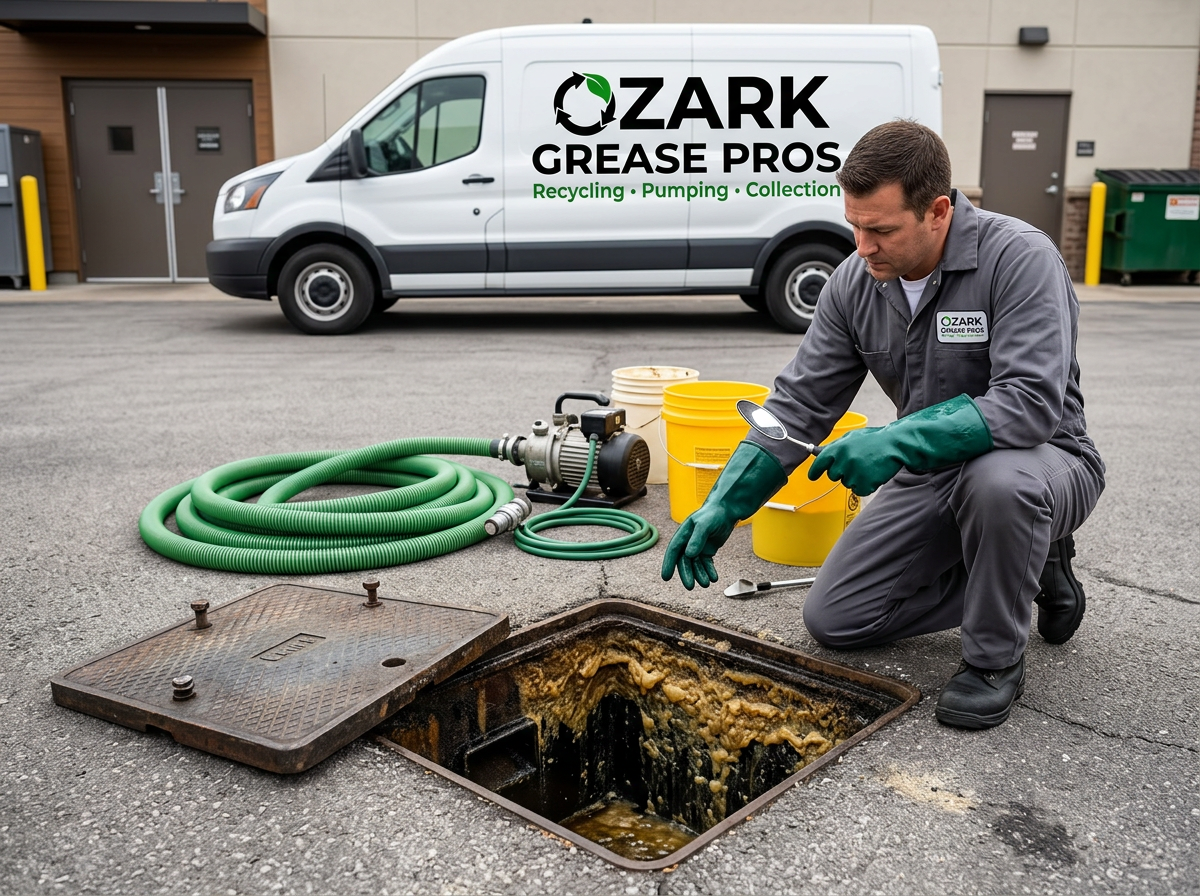
Scheduled Maintenance Programs
Grease Recycling Hub
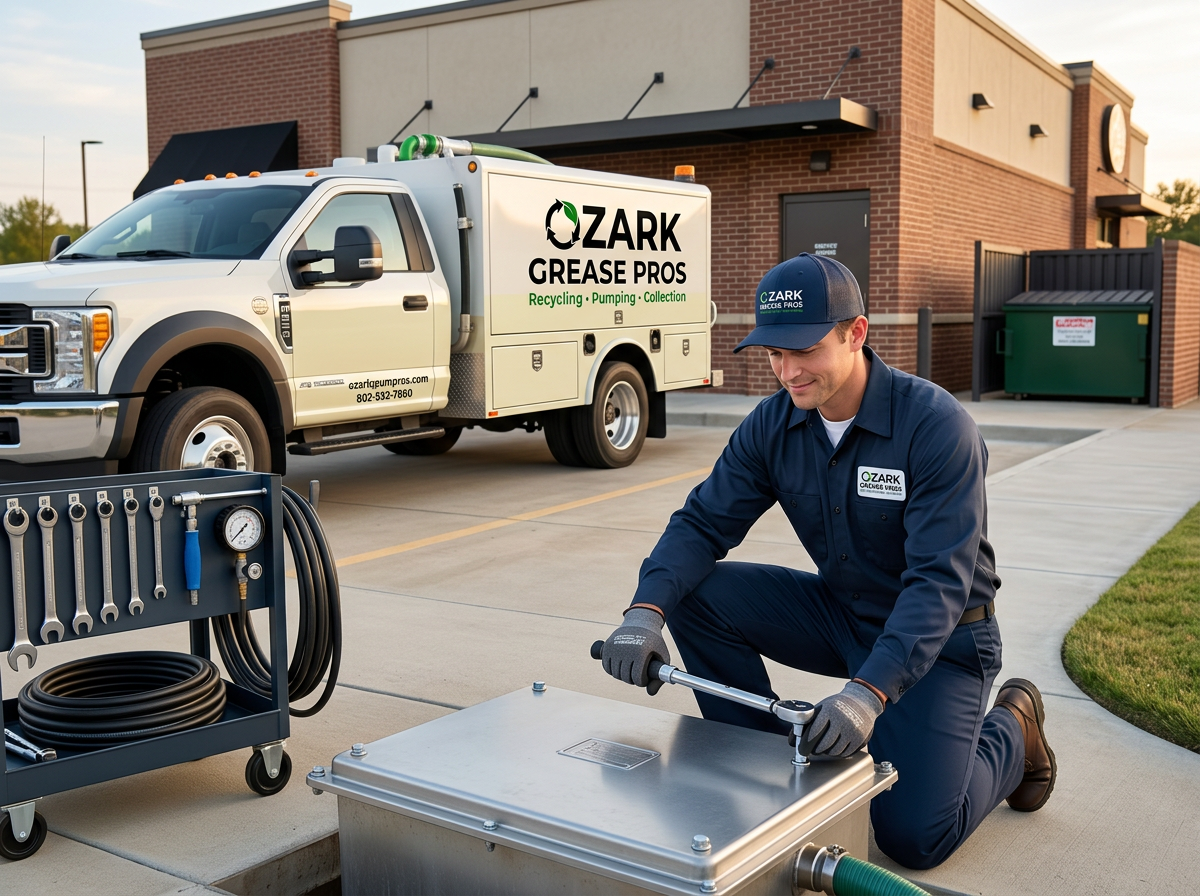
Every Ozark Grease Pros service call produces a fully compliant signed manifest — dated, signed, and naming our ADEQ-licensed Siloam Springs facility as the disposal destination. Get on a maintenance program and your compliance record stays current automatically.